
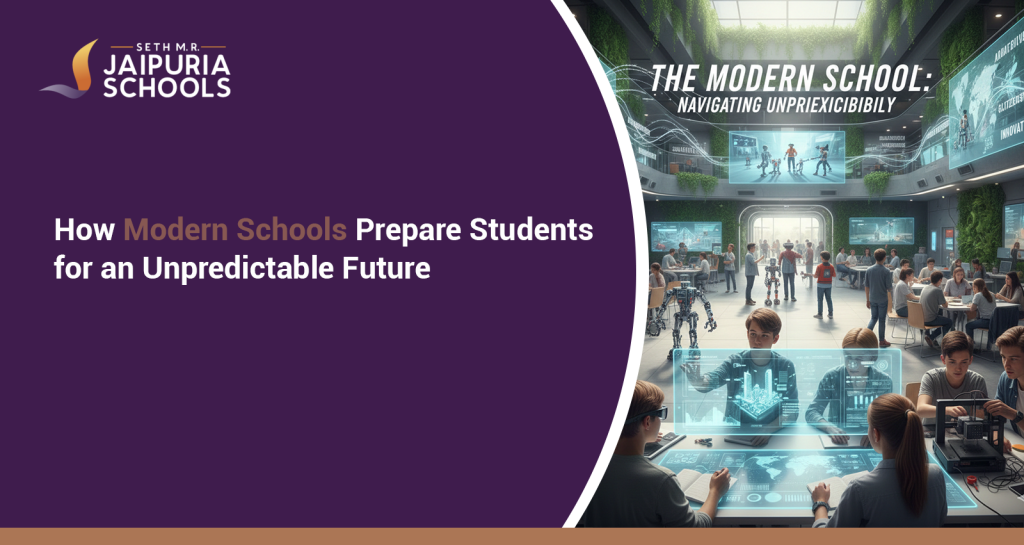
Introduction:
The world that today’s students will step into is vastly different from that of previous generations. Rapid technological advancements, evolving career paths, environmental concerns, and growing global connectivity mean that many future professions have yet to be defined. In this changing landscape, traditional education systems that focus solely on memorisation and examinations are no longer enough. At Jaipuria, recognised among the Top School in Greater Noida, learning is designed to help students adapt, innovate, and lead with confidence amid uncertainty.
Modern education is being reshaped to meet these emerging demands. By combining strong academic foundations with critical thinking, emotional intelligence, digital competence, and ethical understanding, schools equip learners to manage complexity and embrace change. This article examines how future-focused education prepares students for an unpredictable world and why parents increasingly value learning models that build readiness beyond textbooks and exams.
About Us:
Preparing students for an ever-changing world is central to our educational philosophy. Learning here goes beyond textbooks to focus on adaptability, innovation, and real-world problem-solving. Students are encouraged to think critically, collaborate effectively, and explore creative solutions through project-based learning, technology-integrated classrooms, and hands-on experiences.
Co-curricular activities such as robotics clubs, science exhibitions, innovation challenges, sports programs, and creative arts provide platforms for skill development and self-discovery. Regular workshops, competitions, and experiential learning events help students build confidence and resilience. By blending academic excellence with future-ready skills and diverse extracurricular exposure, the school ensures learners are well-equipped to navigate uncertainty and succeed in evolving global environments.
Understanding the unpredictable future students will face
To prepare learners effectively, schools must first understand the nature of the challenges ahead. The future is defined by:
-
Technological disruption: Artificial intelligence, automation, and data-driven decision-making are reshaping industries.
-
Evolving careers: Linear career paths are giving way to multi-disciplinary roles and lifelong learning.
-
Global challenges: Climate change, public health crises, and social inequality require collaborative problem-solving.
-
Information overload: Students must learn to evaluate information critically in a digital-first world.
-
Cultural diversity: Global mobility and digital connectivity demand cross-cultural understanding.
Modern education recognises that success in such a world depends on adaptability rather than predictability.
From rote learning to skill-based education
One of the most significant shifts in modern schooling is the move away from rote memorisation toward skill-based learning. While academic knowledge remains important, how students use that knowledge matters even more.
Key future-ready skills developed in modern schools:
-
Critical thinking and problem-solving
-
Creativity and innovation
-
Communication and collaboration
-
Emotional intelligence
-
Decision-making under uncertainty
Classrooms are becoming interactive learning spaces where students question, analyse, design, and reflect rather than simply recall information.
Strong academic foundations with real-world relevance
Modern schools maintain rigorous academic standards while ensuring that learning connects with real-life applications. Mathematics, science, languages, and humanities are taught through contexts that reflect real-world challenges.
Examples include:
-
Project-based science experiments addressing environmental concerns
-
Mathematics applied to financial literacy and data interpretation
-
Language learning through debates, presentations, and storytelling
-
Social sciences linked to current global and civic issues
This approach ensures conceptual clarity while making learning meaningful and practical.
Emphasis on critical thinking and inquiry-based learning
Inquiry-based learning encourages students to ask questions, explore possibilities, and find solutions independently. Instead of providing ready-made answers, teachers guide students through the learning process.
Benefits include:
-
Improved analytical reasoning
-
Greater intellectual curiosity
-
Confidence in independent thinking
-
Ability to handle complex, open-ended problems
Such skills are essential in a future where answers may not be clear-cut and challenges may be unfamiliar.
Integrating technology as a learning tool
Technology is a powerful enabler when used responsibly. Modern schools integrate digital tools to enhance learning rather than replace human interaction.
Key aspects of technology integration:
-
Smart classrooms and interactive learning platforms
-
Coding, robotics, and computational thinking programs
-
Research-based learning using credible digital resources
-
Digital collaboration and presentation tools
Equally important is teaching digital citizenship, helping students understand online safety, ethical technology use, and responsible digital behaviour.
Developing adaptability and lifelong learning habits
In an unpredictable future, the ability to learn continuously is crucial. Modern schools cultivate a growth mindset by encouraging students to view challenges as opportunities for learning rather than obstacles.
Strategies include:
-
Reflective learning journals
-
Feedback-driven assessments
-
Exposure to diverse learning experiences
-
Encouragement of experimentation and innovation
Students learn that learning does not end with graduation—it is a lifelong journey.
Focus on emotional intelligence and mental well-being
Academic excellence alone cannot guarantee success in a complex world. Emotional intelligence plays a vital role in personal and professional life.
Modern schools actively promote:
-
Self-awareness and self-regulation
-
Empathy and respect for others
-
Stress management and resilience
-
Positive relationships and teamwork
Counselling programs, mindfulness activities, and supportive teacher-student relationships help students build emotional strength to handle uncertainty and change.
Leadership, collaboration, and communication skills
Future leaders must work across teams, cultures, and disciplines. Modern schools provide platforms for students to develop leadership and collaboration skills early on.
Opportunities include:
-
Student councils and leadership programs
-
Group projects and collaborative learning tasks
-
Public speaking, debates, and presentations
-
Team-based sports and cultural activities
Through these experiences, students learn accountability, confidence, and effective communication.
Global awareness and cultural competence
Preparing students for the future also means preparing them for a globally connected world. Modern schools expose learners to diverse cultures, perspectives, and global issues.
This is achieved through:
-
Global curriculum themes
-
Cultural exchange programs and events
-
Discussions on international challenges
-
Encouragement of multilingual learning
Such exposure fosters open-mindedness and respect—qualities essential for global citizenship.
Values and ethics in modern education
In a rapidly changing world, strong values act as an anchor. Modern schools integrate ethical education and social responsibility into everyday learning.
Students are encouraged to:
-
Make responsible choices
-
Understand the impact of their actions
-
Contribute positively to society
-
Respect diversity and inclusivity
Value-based education ensures that future professionals are not only skilled but also principled.
Role of co-curricular activities in future readiness
Learning beyond the classroom plays a vital role in shaping adaptable individuals. Sports, arts, clubs, and community service programs help students explore interests and develop transferable skills.
Benefits include:
-
Teamwork and discipline through sports
-
Creativity and self-expression through arts
-
Problem-solving and innovation through clubs
-
Social responsibility through community engagement
These experiences complement academic learning and prepare students for varied life situations.
Assessment methods aligned with future skills
Modern schools are redefining assessment to reflect holistic development. Instead of relying solely on traditional exams, they use diverse evaluation methods such as:
-
Project work and presentations
-
Portfolios and reflective assignments
-
Skill-based assessments
-
Continuous feedback systems
This approach recognises effort, growth, and understanding rather than rote performance.
Teacher as mentor and facilitator
Teachers in modern schools play a crucial role as mentors who guide students through exploration and discovery. Their role extends beyond instruction to include motivation, emotional support, and personalised guidance.
Continuous professional development ensures that educators stay updated with modern pedagogies, technology, and student psychology.
Preparing students for future careers
While no school can predict exact career paths, modern education equips students with transferable skills applicable across industries. Career awareness programs, exposure to emerging fields, and skill-based learning ensure students are ready to adapt to new opportunities.
Students graduate with:
-
Confidence in their abilities
-
Clarity about strengths and interests
-
Readiness to learn and re-skill
-
Ethical and social awareness
Why parents prioritise future-ready education
Parents seeking the school increasingly look beyond academic results. They value institutions that prepare children to face uncertainty with confidence, resilience, and responsibility.
Future-ready education offers:
-
Balanced academic and personal growth
-
Strong moral and emotional foundations
-
Global perspective and adaptability
-
Skills relevant to the evolving world
Conclusion:
The unpredictability of the future demands a new approach to education—one that nurtures adaptable thinkers, empathetic leaders, and lifelong learners. Modern schools rise to this challenge by blending academic excellence with skills, values, and global awareness.
By preparing students to think critically, learn continuously, collaborate effectively, and act responsibly, modern education ensures that learners are not just ready for the future but capable of shaping it. For families searching for the school, future-focused education stands as the key to long-term success and meaningful growth.
FAQs:
Q1. What makes modern education different from traditional learning?
Modern education focuses on skills like adaptability, critical thinking, and creativity, not just exam preparation.
Q2. How are students prepared for careers that don’t yet exist?
By developing transferable skills such as problem-solving, communication, and continuous learning habits.
Q3. Why is adaptability considered a key future skill?
Because students must learn to respond confidently to change, uncertainty, and new challenges.
Q4. How does technology support future-ready learning?
Technology enhances research, collaboration, innovation, and digital literacy when used responsibly.
Q5. Do modern schools still prioritise strong academics?
Yes, academic excellence remains essential, but learning is connected to real-world applications.
Q6. How does future-focused education build student confidence?
By encouraging exploration, resilience, and independent thinking rather than fear of failure.